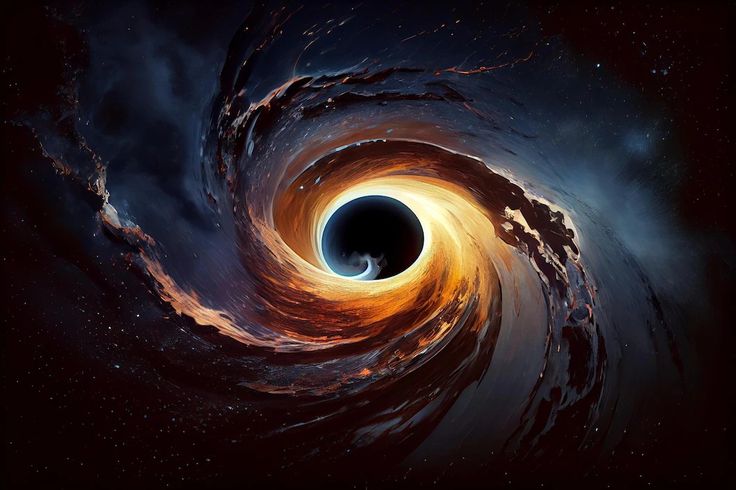
“There are places in the universe where time bends, light disappears, and the laws of physics go silent. We call them black holes. And now, they’re speaking to us.”
In the vast stillness of space, where islands of light drift like islands of light, something momentous occurred—in secret, without forewarning, but with aftershocks that might redefine our understanding of the universe itself.
On Nov. 23, 2023, a gentle ruffling of spacetime passed through Earth. It was shorter than a blink—just a tenth of a second—but in that whisper was left the imprint of the largest black hole merger detected to date.
Two massive black holes, already titanic beyond one’s thought, whirled towards each other and combined, birthing a 225-solar-mass black hole, the largest thus far detected from a gravitational wave observation. This occurrence, now astrophysical heritage under the designation GW231123, was not another celestial event. It transcended theoretical boundaries, defying.
This wasn’t just a detection.
It was a moment that shook the foundations of modern cosmology, forcing scientists to rethink what they thought they knew about how black holes are born, grow, and possibly even evolve in ways we’ve never considered. It was a gentle reminder that the universe still keeps secrets—and sometimes, it shares them not with a roar, but with a whisper in the dark.
What Was Detected?
Two black holes: ~100 M☉ and ~140 M☉
(Both fall in the “mass gap,” where black holes theoretically shouldn’t form via stellar collapse.)Merged to form: 225 M☉ black hole
(The largest ever observed through gravitational waves; classified as an intermediate-mass black hole.)Detected by: LIGO–Virgo–KAGRA collaboration
(An international network of gravitational wave observatories.)Signal duration: ~0.1 seconds
(A very short and sharp signal, suggesting a rapid and massive final spiral before collision.)Estimated distance from Earth: Billions of light-years
(Exact distance still being refined by astronomers.)Spin rates: Both black holes were likely spinning near their physical limits
(Suggests they may have been formed from previous black hole mergers—“second-generation” black holes.)Scientific significance:
Breaks the existing black hole mass record (previously ~140 M☉).
Challenging current models of black hole formation and stellar death.
Provides new evidence of intermediate-mass black holes, long considered a “missing link” in cosmic evolution.
These numbers—100 solar masses, 140 solar masses, 225 solar masses—might sound like dry astronomy jargon. But beneath those figures lies a startling truth that has astronomers scratching their heads.
Here’s the thing: black holes this big were never supposed to be born like this.
According to our current understanding of how stars live and die, there's a kind of “no man’s land” in the black hole size chart—a mysterious blank space known as the “mass gap.” It's a range between roughly 60 and 130 times the mass of our Sun, where black holes simply aren’t expected to form through the usual process of stellar collapse.
Why? Because when stars that massive reach the end of their lives, they don’t quietly collapse into black holes. They explode in such a violent supernova—called a pair-instability supernova—that they tear themselves completely apart, leaving nothing behind. No remnant. No core. Just stardust scattered into space.
So, when scientists detected not one but two black holes right inside that forbidden zone, they were stunned. It’s like finding footprints where no one was supposed to be able to walk.
And when those two "impossible" black holes collided and created an even more massive one—225 solar masses—it didn't just defy expectations. It cracked open the door to a whole new mystery in the life cycle of stars and the birth of black holes.
Why Is This Merger So Mysterious?
Black holes usually form when very massive stars reach the end of their lives, collapsing under their gravity. But here's the twist: if a star is too massive, it doesn’t leave behind a black hole at all. Instead, it ends in a super-powerful explosion—a rare kind called a pair-instability supernova—which is so intense, it blows the entire star to bits, leaving nothing behind. Not even a core. Not even a black hole.
That’s why scientists believed there’s a “mass gap”—a forbidden zone in the black hole family between 60 and 130 solar masses. In theory, black holes simply shouldn’t exist in this range.
And yet… the two black holes in this cosmic collision were right in the middle of it.
How did they get there?
This is the puzzle that now has astrophysicists buzzing. And while no one has a definitive answer yet, a few bold possibilities are on the table:
🌀 Repeated mergers:
Maybe these weren’t first-generation black holes at all. Maybe they were formed from earlier black hole collisions, deep in some ancient star cluster. If so, what we witnessed is not just a merger, but a kind of black hole family tree, several generations in the making.🌌 Dense star clusters:
Some parts of the universe—like globular clusters or galactic cores—are so densely packed with stars and remnants that black holes bump into each other more frequently. In such chaotic environments, it’s easier for these giants to find partners and grow rapidly through multiple collisions.🧬 Exotic physics:
This event may reflect a process we don’t fully understand yet. Maybe nature has a hidden trick up its sleeve—some mechanism of black hole formation beyond current models. Something that bends the rules and expands our understanding of cosmic evolution.
In short, this merger didn’t just break records—it broke the rules.
And in doing so, it’s pushing science to ask deeper questions about how black holes really form, grow, and possibly evolve beyond our current imagination.
What Is an Intermediate-Mass Black Hole?
For years, astronomers have spoken of black holes in two main categories:
Stellar-mass black holes—These are the “common” ones, formed when massive stars die. They usually weigh anywhere between a few to a few dozen times the mass of our Sun.
Supermassive black holes—the cosmic giants, sitting at the centres of galaxies, including our own Milky Way. These behemoths can be millions—or even billions of-solar masses.
But what lies in between?
That question has puzzled scientists for decades. Because somewhere between those two extremes, in the shadowy middle ground, lives a mysterious class known as intermediate-mass black holes.
They’re not too small. Not impossibly large. But they’ve always been incredibly hard to find. Some even wondered if they existed at all.
And then came the signal—GW231123. A 225-solar-mass black hole, born from a record-breaking merger, suddenly shouted its presence through gravitational waves.
This wasn’t just a detection. It was the birth cry of a long theorised but rarely observed cosmic creature.
Intermediate-mass black holes could be the missing link in how black holes grow, from stellar corpses to galactic monsters. They might be the building blocks that eventually merge to become the supermassive titans anchoring galaxies.
We still don’t know how many are out there.
But thanks to this incredible event, we now know they are real. And they are forming.
Gravitational Waves: The Universe’s Subtle Pulse
What made this groundbreaking discovery possible wasn’t a telescope.
It wasn’t light.
It was something far more subtle—gravitational waves.
First predicted by Einstein over a century ago, gravitational waves are ripples in the very fabric of space and time, created when massive objects like black holes crash into each other. Imagine tossing a stone into a calm pond—the ripples that spread outward are what gravitational waves do to the universe.
On Earth, we now have detectors—LIGO in the U.S., Virgo in Europe, and KAGRA in Japan—so sensitive they can pick up these ripples from billions of light-years away. They don’t see the event… they hear it. A faint, brief whisper in the cosmic silence.
And that’s exactly what happened on November 23, 2023.
The wave lasted only a tenth of a second—a fleeting moment. But in that flash of spacetime distortion, we witnessed the birth of the largest black hole merger ever recorded. It was like the universe held its breath… and then exhaled a secret we had never heard before.
In that tiny sliver of time, we learnt more about black holes than we had in decades of watching them in silence.
Because sometimes, in the universe, it’s not the light that reveals the truth—it’s the ripples in the dark.
What This Means for Science
This wasn’t just another entry in the gravitational wave catalogue.
This single event has cracked open a new door in our understanding of the universe.
First, it shattered the previous black hole mass record. Until now, the biggest merger we had seen created a black hole of around 140 solar masses (GW190521). But this one? It reached 225—a leap that stunned scientists.
Second, it forces astrophysicists to rethink how black holes form. For decades, we believed certain mass ranges were off-limits—“forbidden zones” in black hole creation. But now, those theories are under pressure. Nature, it seems, doesn’t follow our textbooks.
Third, it hints at exotic cosmic environments—places like dense star clusters, where black holes might collide, merge, and grow repeatedly. Picture hidden nurseries in the universe, where black holes are quietly building into giants.
And finally, it makes us wonder:
How many other such events have we missed?
A wave that lasted just 0.1 seconds was all it took to reveal this one. If we blink, how many other cosmic giants might pass us by, undetected?
In short, this detection isn’t just a milestone—it’s a turning point.
It opens a new chapter in cosmic evolution and reminds us of a humbling truth:
The universe still holds secrets we're only beginning to hear
"This event wasn’t just massive—it was astonishing. We may be witnessing an entirely new way that black holes grow in the universe."
— Astrophysicist Christopher Berry
(LIGO Scientific Collaboration)
Final Thoughts: Mystery in the Darkness
Black holes have long been symbols of the ultimate unknown—places where gravity is so intense, not even light can escape, and where our understanding of physics begins to unravel.
They’ve always been mysterious, almost mythical in their silence.
But now, we know they are more than just voids.
They are cosmic messengers—carving their presence into the fabric of space-time, sending whispers across the universe that reach us as ripples in gravity itself.
This most recent black hole merger isn’t just the biggest we’ve ever recorded.
It’s a celestial signal, reminding us that the universe isn’t silent… It’s just subtle.
And when we listen closely enough—with the right instruments, the right questions, and a sense of wonder—we find that space itself speaks.
It tells us stories of creation, destruction, and rebirth.
And sometimes, as in this case, it tells us something we never expected to hear.
In a tenth of a second, the universe rewrote the rules.
And it’s only just begun.
Pause and wonder:
If the universe can create something this immense, what other secrets are still waiting in the silence?
Additional:-
Key Milestones in Gravitational Wave Discoveries
🌀 September 14, 2015 – GW150914
First-ever gravitational wave detected by LIGO.
Two black holes: 29 M☉ + 36 M☉
Final black hole: 62 M☉
Confirmed Einstein’s prediction from General Relativity (1916).
🌌 May 21, 2019 – GW190521
First detection of a black hole in the “mass gap” (60–130 M☉).
Merging black holes: 85 M☉ + 66 M☉
Final black hole: 142 M☉
First strong evidence of an intermediate-mass black hole.
🚨 November 23, 2023 – GW231123
The most massive black hole merger ever recorded.
Merging black holes: ~100 M☉ + ~140 M☉
Final black hole: 225 M☉
Detected by: LIGO–Virgo–KAGRA
Duration of signal: ~0.1 seconds
Shake existing theories of black hole formation.
Did You Know?
The energy released in the GW231123 black hole merger was equivalent to several Suns being converted directly into pure gravitational energy, in less than one second.
In the endless dark between the stars, something stirred—and in just one fleeting ripple, the universe reminded us that we have so much more to learn.