"What if everything we know about nature—the forces that move planets, bind atoms, and shape galaxies—isn’t the full story?
Hello, dear friends,
We often grow up believing that the universe is ruled by four fundamental forces: gravity, electromagnetism, and the two nuclear forces. It feels complete, doesn’t it? Neatly packaged, comfortably certain.
But science is rarely about comfort; it’s about discovery.
And sometimes, nature whispers that there’s more.
Recently, a quiet lab in Zurich may have picked up one such whisper.
Researchers from ETH Zurich, alongside teams from Germany and Australia, were studying atoms, not to break them apart, but to listen more closely than ever before. And in the delicate dance of calcium isotopes, they found something… strange.
A possible sign of a fifth force.
No particle colliders. No explosions. Just careful, precise observation and results that don’t quite fit the rulebook we’ve followed for decades.
Could this be the missing piece behind mysteries like dark matter? Could it reshape physics as we know it?
Let’s take a journey into what scientists are calling one of the most promising signs that our universe still holds secrets in plain sight.
What Is a Fifth Force, and Why Do Scientists Think It Exists?
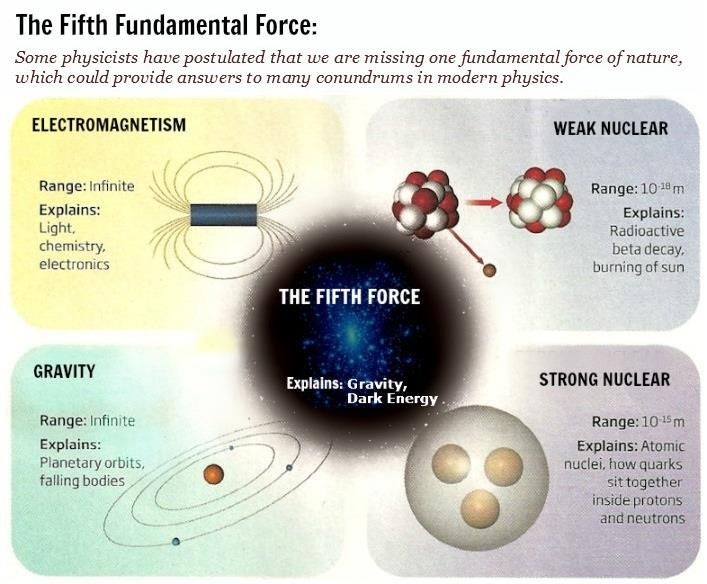
For decades, science has relied on four fundamental forces to explain almost everything in the universe. They’re like the pillars holding up the structure of reality. Let’s revisit them quickly:
Gravity keeps planets in orbit and your feet on the ground.
Electromagnetism powers everything from lightning to your phone.
The strong nuclear force holds atomic nuclei together.
The weak nuclear force makes radioactive decay and nuclear fusion possible.
These forces form the foundation of what's called the Standard Model of Physics. It’s a framework that explains how particles behave, interact, and form the universe as we know it.
But here's the thing: the Standard Model is brilliant, but it’s incomplete.
It can’t explain some of the universe’s biggest mysteries. Like why galaxies spin faster than they should. Or why 85 percent of the matter in the universe, known as dark matter, is completely invisible yet clearly influencing everything around it.
For years, physicists have wondered. What if there's another force out there? A hidden force that we haven’t yet understood. A fifth force that subtly shapes reality, just outside our current vision.
That idea has always lived in theory. Until now.
What Did the Scientists at ETH Zurich Find?
This isn’t a story about giant particle colliders or billion-dollar machines. It's about precision and patience. About listening to atoms more closely than ever before.
The researchers studied calcium ions, tiny atoms stripped of some electrons, and compared different versions called isotopes. These isotopes are nearly identical, except for a small difference in their nuclear mass.
Using an ultra-sensitive tool called laser spectroscopy, they measured tiny shifts in how these isotopes absorb light. And they found something... off.
A small but significant deviation that shouldn’t exist, at least, not according to our current physics.
This anomaly has no obvious explanation. Unless, perhaps, there's an unknown force subtly nudging these particles in ways we've never seen before.
The possibility? It might be evidence of a fifth force of nature.
Why This Could Be a Breakthrough for Understanding Dark Matter
Dark matter is one of the greatest puzzles in modern science.
We can’t see it. We can’t touch it. We can’t even detect it directly.
But we know it’s there.
Why? Because galaxies spin too fast for the amount of visible matter they contain. Stars at the edges of galaxies move as if there's something massive and invisible pulling on them. That "something" is what we call dark matter.
Now here’s where it gets exciting.
The force we think might be influencing those calcium isotopes? It may also be the very thing interacting with dark matter. Not in the usual ways we understand, not through gravity or electromagnetism, but through something entirely new.
This fifth force could act as a kind of bridge between regular matter and the hidden world of dark matter.
It might explain:
Why dark matter clumps together the way it does.
Why does it seem to interact so weakly with light and particles?
And maybe even what it's made of.
In other words, if this fifth force is real, we might finally have a way to pull back the curtain on one of the universe's biggest secrets.
It’s like finding a fingerprint on something we’ve only ever guessed existed.
And that fingerprint could open up a brand-new chapter in physics.
How Is This Research Different From Past Theories?
For decades, physicists have speculated about the possibility of a fifth force. It’s not a new idea.
But until now, every attempt to find it has either come up empty or lacked precision.
Most earlier experiments looked for it in large, energetic environments. Think giant particle accelerators smashing atoms together or deep underground detectors waiting for dark matter to reveal itself. These are powerful tools, but they also bring complexity and noise, and often, uncertainty.
This new approach is different. Very different.
Instead of going big, these researchers went small.
They turned their attention to atomic energy levels, the tiny steps electrons take inside atoms when they absorb light.
By comparing how two nearly identical calcium isotopes absorb laser light, they were able to measure shifts with incredible sensitivity. So sensitive that they could detect differences smaller than a billionth of a percent.
The fact that they saw a mismatch, one that the Standard Model doesn’t account for, is what caught everyone’s attention.
It’s not just the result.
It’s the method —clean, precise, and repeatable—that makes this such a potential game-changer.
And most importantly, it’s something that can now be tested in other labs around the world. Because if multiple independent teams see the same thing… that’s when a new force of nature goes from possibility to reality.
Conclusion: What If the Universe Is Still Whispering?
Science is often portrayed as a race to answers. Equations, theories, proofs. But sometimes, it’s about something quieter, a pause, a puzzle, a tiny mismatch in a lab that makes you stop and ask, “What if?”
That’s what this discovery feels like.
A whisper from the universe. Not loud, not flashy, but deeply meaningful.
Because if this fifth force exists, then nature has just tapped us on the shoulder and said,
“You don’t know me fully yet.”
It’s a reminder that our understanding of the cosmos, even after centuries of progress, is still evolving.
That we haven’t reached the limits of knowledge. We’re still just beginning to listen with enough patience, precision, and humility.
This isn’t just about atoms or forces. It’s about the human spirit, our endless need to explore, to ask questions, and to lean into mystery instead of running from it.
We often think the next great leap will come from something big, a giant telescope, a rocket, or a supercollider. But this time, it came from looking at a speck of calcium and noticing a small, stubborn difference.
And maybe that’s the real message.
That the universe doesn’t always shout.
Sometimes, it whispers.
And when it does, it’s up to us, curious, imperfect, hopeful humans, to listen.
So whether or not this fifth force turns out to be real, one thing is certain:
The search has begun. And that, in itself, is a beautiful kind of progress.
Thank you for joining us on this quiet yet profound journey through the mysteries of nature.