Mauryan Period Evidence of the Yudhishthira–Nahusha Dialogue :—
In the Vana Parva of the Mahabharata, particularly in the Ajagara Parva, the cursed king Nahusha appears in the form of a giant serpent (ajagara). During the exile of the Pandavas, he encounters Yudhishthira and engages in a deep philosophical dialogue with him.
Interestingly, a Mauryan-period inscription dated around 200 BCE has been discovered in Ajgara. The inscription refers to Nahusha associated with the serpent narrative.
The coincidence is quite striking:
# The place where the inscription was found is named Ajgara.
# In the epic, Nahusha becomes an ajagara (serpent) due to a curse.
# The Mahabharata episode describing this event is known as the Ajagara Parva.
These correspondences suggest that the tradition of the Nahusha–Yudhishthira dialogue was already known in society during the Maurya period.
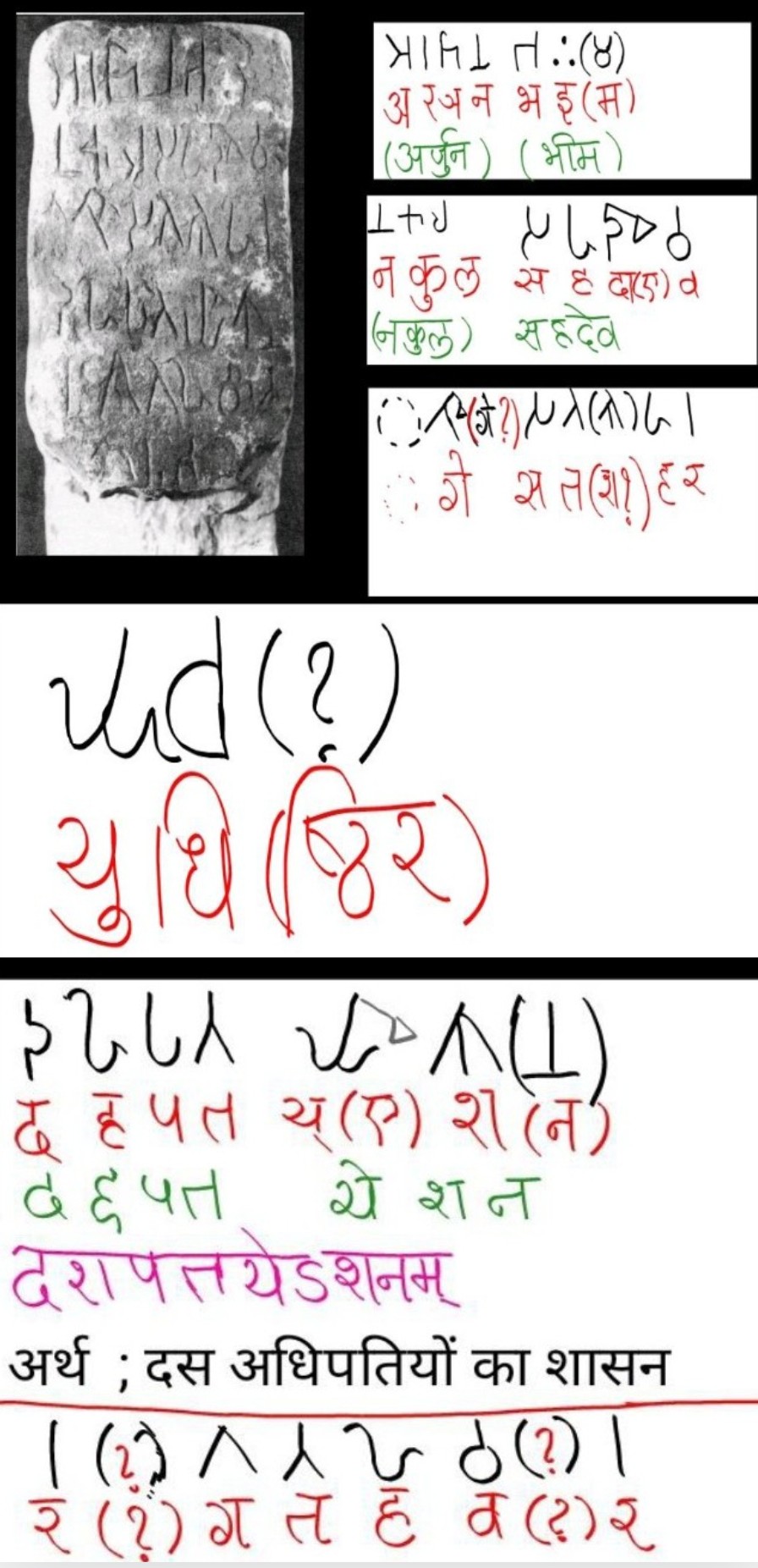
Source — THE FIRST AJAGARĀ INSCRIPTION
From Professor S.N. Roy's article, 'An Early Epigraphic Reference to the Yaksha Cult (Roy 1988: 79-80, 82).
A Tocharian Manuscript Mentioning the Ashwatthama Episode :—
Another remarkable reference appears in a manuscript written in Tocharian B, discovered in Kizil Ming-Öy and preserved in the Berlin Turfan Collection.
Such manuscripts are usually dated to the 6th–7th century CE, roughly corresponding to the Late Gupta period.
A surviving line from the manuscript reads:
Transliteration:
b2 /// ·v· [tth]· m· sū ma ntre ki wai ke we ña : wro ttse wlo yu dhi ṣṭhī re tu sā kla ///
Transcription:
24a (sruka) (aś)v(ā)tth(a)m(e) sū mänt reki wai ke weña
24b wrottse wlo yudhiṣṭhīre tusā kla
Translation:
“Ashvatthama died.
He thus spoke a lie.
Therefore the great king Yudhishthira…”
This clearly refers to the well-known episode where Yudhishthira declares the death of Ashwatthama in order to demoralize Drona during the Kurukshetra war.
The presence of this narrative in a Central Asian manuscript demonstrates that the traditions of the Mahabharata had spread far beyond India and were known in other linguistic and cultural regions as well.

Source — https://cetom.univie.ac.at/?m-tht133
Spitzer Manuscript Fragment :—
Another important piece of evidence comes from the Spitzer Manuscript, which is generally dated to around the 1st–2nd century CE and written in the Brahmi script.
In one of its fragments, there is a mention of different sections (Parvas) of the Mahabharata. What’s especially notable is that names like Śānti Parva and Aśvamedhika Parva appear quite clearly.
Transcription:
///(śā)nt[i]parvvam 15 āśvamedhikam* 1(6)///
///[khi]leşu evam sarvvasya ślokā ..?///
///yādavānām kauravāṇām..y.///
It also includes references to the Yādavas and Kauravas, which are central to the Mahabharata narrative. So this isn’t just a random list of names — it clearly connects with the main storyline we are familiar with.
What this fragment basically shows is that by this time, the Mahabharata wasn’t just floating around as separate stories.
It seems to have had a recognized structure, with clearly named Parvas.
And that’s important, because it suggests that the text had already begun to take a more fixed and organized form by this period.
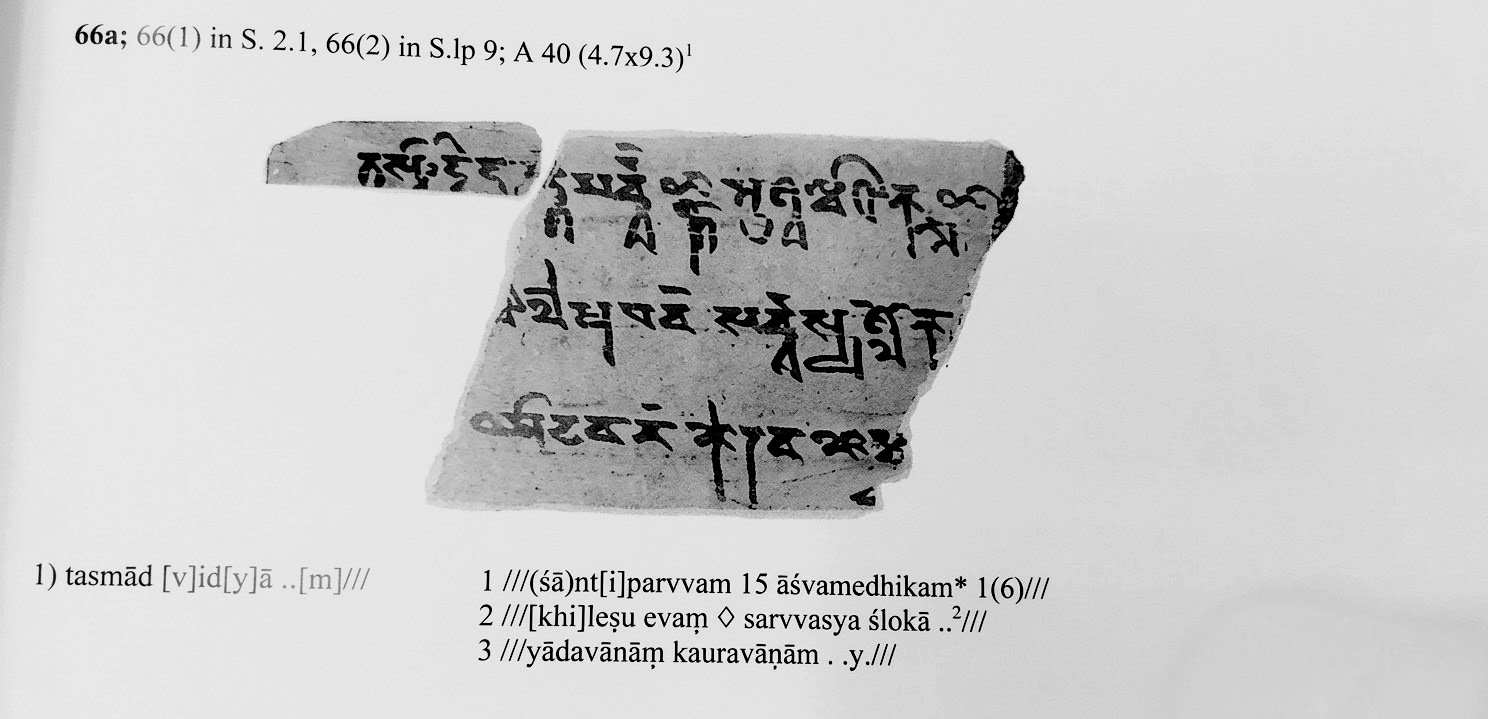
Source — The Spitzer Manuscript by Eli Franco
Who Composed the Mahabharata?
An interesting piece of inscriptional evidence comes from the Harigaon Dvaipāyana Stotra inscription, which belongs to the Gupta period and is dedicated to Vyasa.
In its 24th line, the inscription praises Vyasa and conveys the idea that had the Mahabharata not been composed, the message of the Vedas might have been lost to the world. The tone is clearly reverential and places Vyasa at the center of the composition tradition.
This is significant because it reflects an already established cultural memory in which Vyasa is recognized as the composer of the Mahabharata.
When seen alongside the broader literary and traditional framework, such references reinforce the understanding that the Mahabharata was attributed to Vyasa within the Indian tradition, rather than being a later creation of any external group.
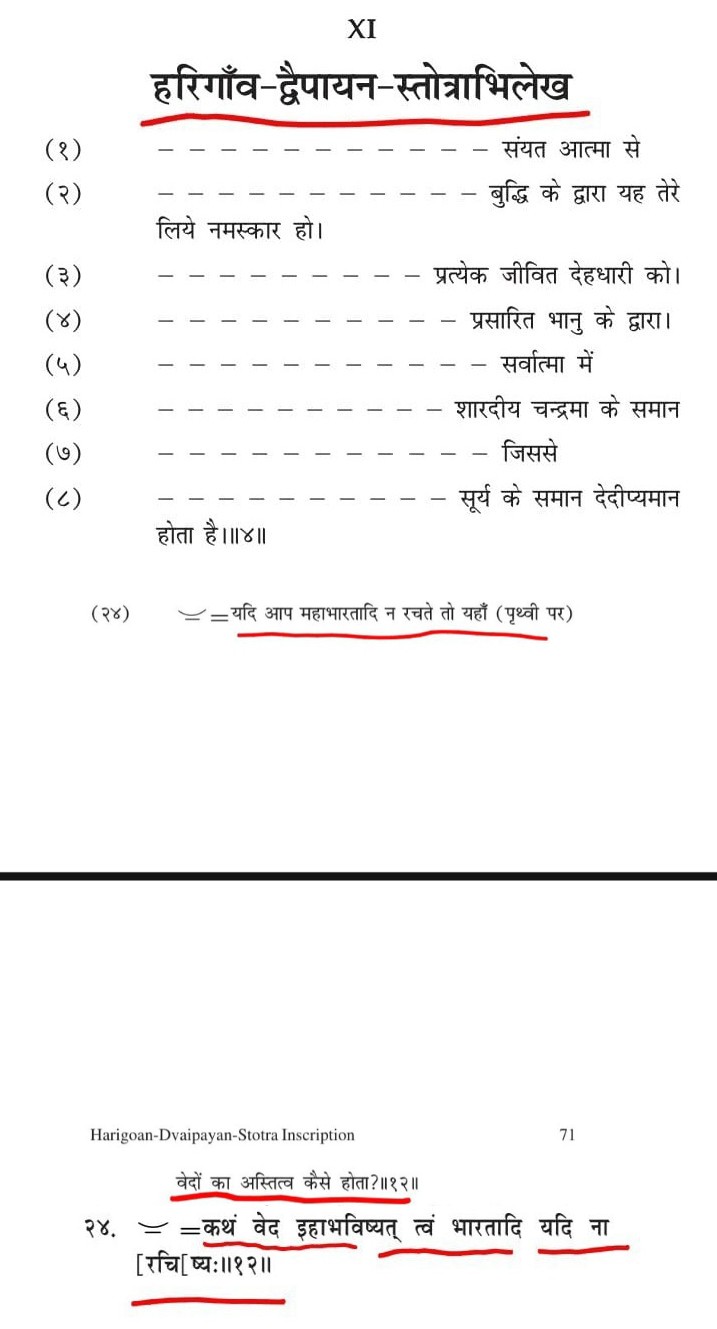
Source — Source — Importance Of Nepalese Sanskrit Inscriptions by Krishna Dev Aggarwal. Page no. 70
Early Rock Art and Possible Parallels
An even earlier visual reference comes from a rock painting discovered in the Swat Valley, generally dated to around 1000 BCE.
The scene appears to depict a large-scale conflict, with multiple human figures engaged in what looks like a battle. Among these figures, one particular depiction stands out — a human figure associated with a wheel (chakra).
This is interesting because similar imagery can be seen on certain Punch-marked coins from around the late 1st millennium BCE (c. 4th century BCE), where a human figure is shown along with a wheel-like symbol. These coins are often associated, in later interpretations, with representations linked to Krishna.
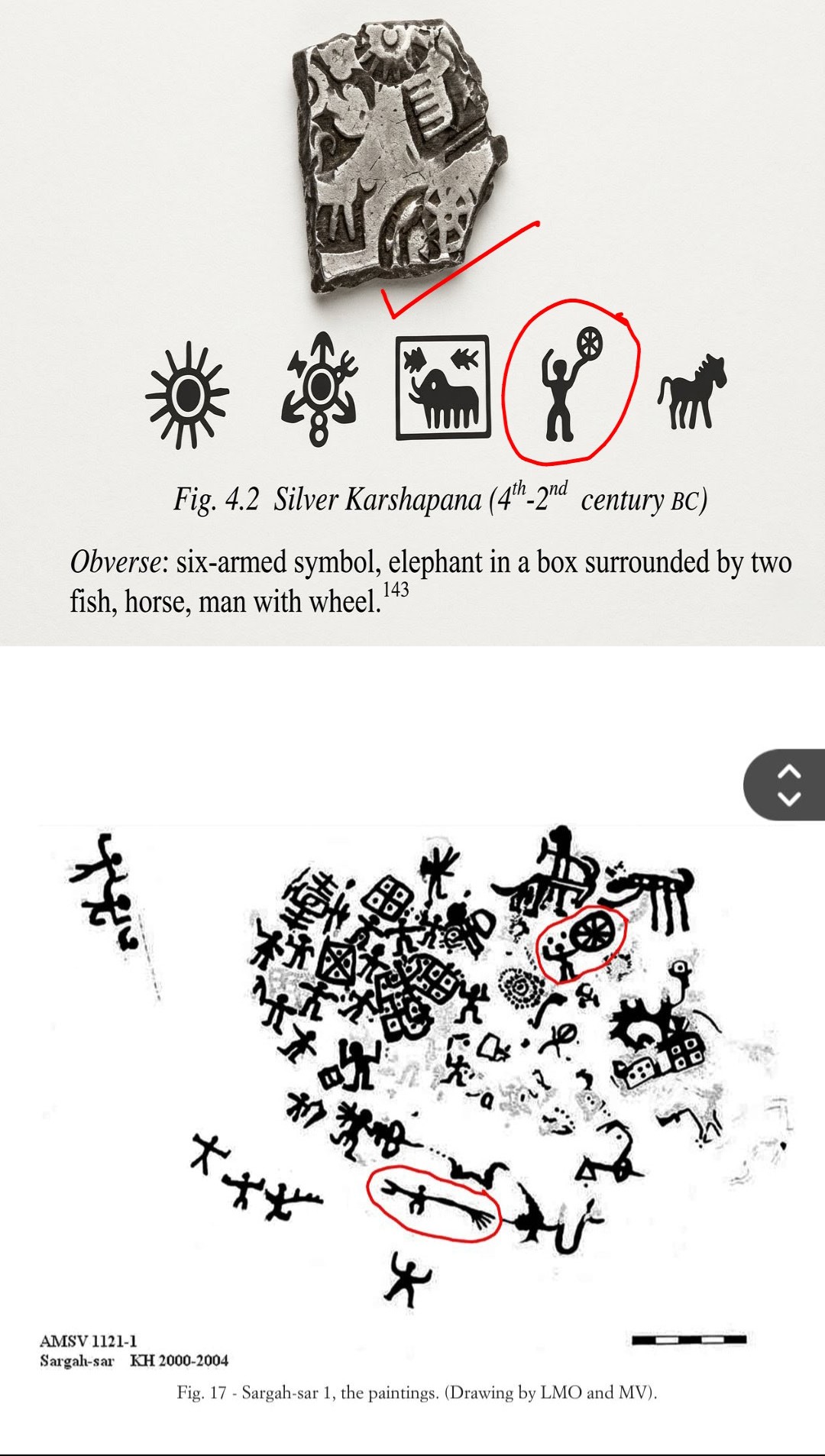
Source — Olivieri, L. M., & Vidale, M. (2006). Archaeology and Settlement History in a Test Area of the Swat Valley: Preliminary Report on the AMSV Project (1st Phase). East and West, Vol. 56 (Nos. 1–3).
Epigraphic Evidence of the Mahabharata
Khoh Copper Plate Inscription Of SarvaNath, Gupta Year 214 :—
An important inscriptional reference comes from the Khoh Copper Plate inscription of Maharaja Sarvanatha, dated to the 214th year of the Gupta era.
In the 19th line of the second plate, the inscription contains the phrase:
“Mahābhārate śatasahasra-saṁhitāyām…”, which refers to the Mahabharata as a text consisting of 100,000 verses.
This is quite significant, as it shows that by the Gupta period, the Mahabharata was already recognized in a form containing approximately one lakh (100,000) ślokas.
From this, it can be reasonably understood that the composition and expansion of the text must have taken place much earlier, long before the Gupta age, allowing enough time for it to reach such an extensive and established form.

Source — Corpus Inscriptionum Indicarum Vol. 3 Page no. 135
Khoh Copper Plate Inscription Of Jayanath , Gupta year 177
Another inscriptional reference comes from the Khoh Copper Plate of Maharaja Jayanatha, dated to the 177th year of the Gupta era.
In the 15th line of the second plate, the phrase “Mahābhārate bhagavatā Vedavyāsena…” appears, which clearly mentions both the Mahabharata and Vyasa.
This is important because it reflects an already established tradition where the composition of the Mahabharata is associated with Vyasa. By this period, not only was the text well known, but its attribution to Vedavyasa was also clearly recognized.
Source — Corpus Inscriptionum Indicarum vol. 3 Page no. 121
Mahabharata in Early Sculptural Art
One of the earliest known visual representations of scenes from the Mahabharata comes from a temple site in Uttar Pradesh, specifically from Ahichchhatra.
This depiction appears as a terracotta sculptural panel carved on a temple wall and is generally dated to around the 5th century CE.
What makes this important is that it shows the Mahabharata was not limited to texts alone. Its narratives had become part of temple art and visual culture, indicating that people were already familiar with its stories. This suggests a deep cultural presence of the epic in society by that time.
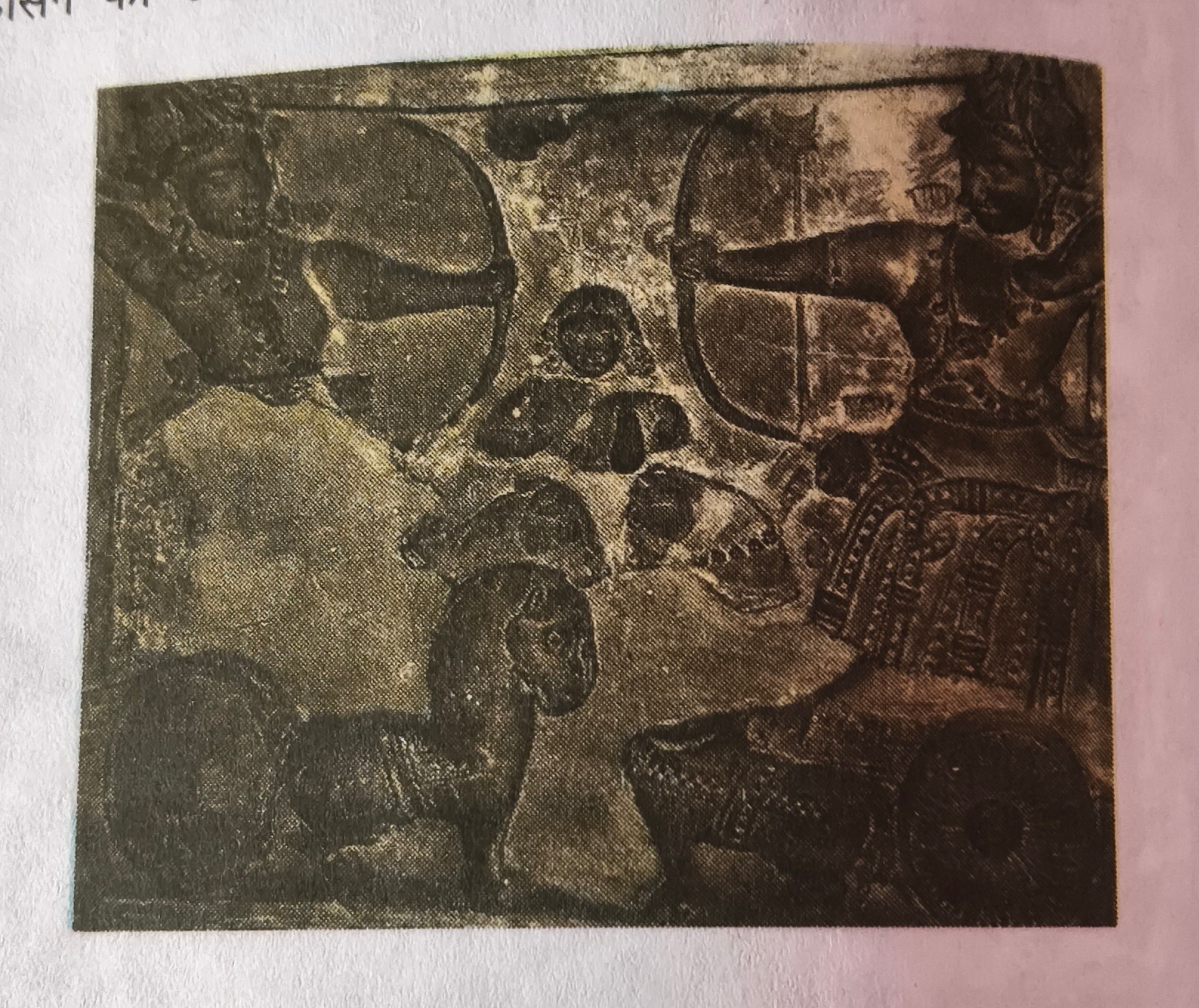
Source — NCERT book Class 12th , part- 1 page no. 60
When Did the Mahabharata War Take Place?
A significant chronological reference comes from the Aihole inscription of Pulakeshin II, dated to 634 CE.
This inscription states that it was issued 3735 years after the Mahabharata war. If we calculate on this basis, counting back 3735 years from 634 CE places the event roughly around 3100 BCE.
This suggests that, according to this inscriptional tradition, the Mahabharata war was believed to have occurred nearly 5000 years ago, around 3000 BCE.
Interestingly, the same inscription also mentions renowned poets like Kalidasa and Bharavi, indicating that they were already well-known and established figures by that time.
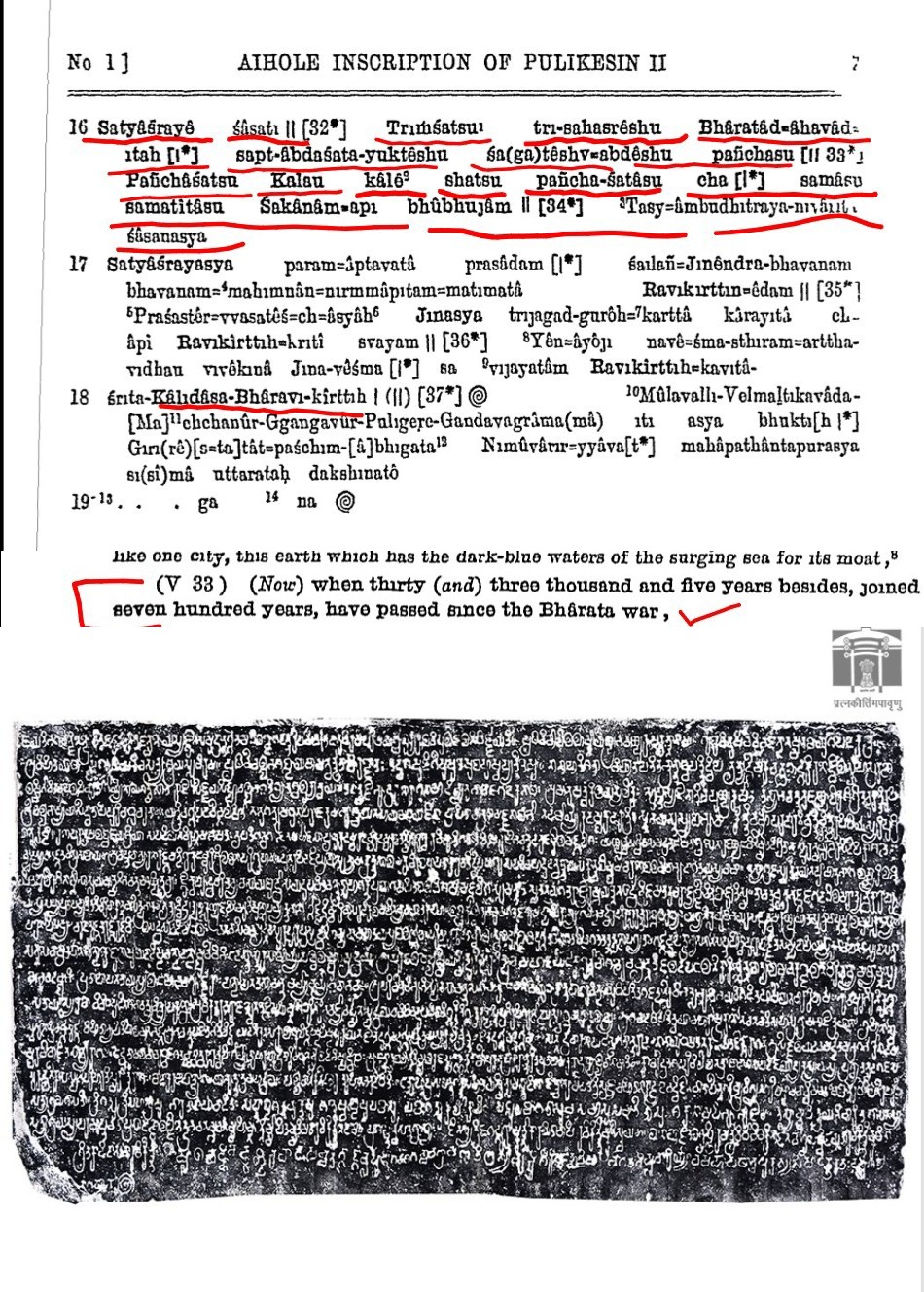
Source — Epigraphia Indica vol. 6 , page no. 7
Conclusion
When all the available evidence is viewed together—ranging from early inscriptions and copper plates to manuscripts, artistic depictions, and even references found beyond India—a broader and more consistent picture begins to emerge about the Mahabharata. The traditions associated with the epic were not only widely known but had already developed a structured form, clear authorship attribution to Vyasa, and a deep cultural presence across different regions and time periods. Rather than pointing toward a late or external origin, these diverse sources collectively suggest a long and continuous development within the Indian tradition, with the text and its narratives firmly established well before the periods in which these evidences appear.
This is only the first part of the discussion. In the next part, further evidence and perspectives will be explored to deepen the understanding of the Mahabharata’s antiquity and transmission.